createSurfaceMap <- function(df, var_name, legend_min, legend_max){
  # additional: parameters
  # model = try "Sph" (spherical), "Exp" (exponential) or "Gau" (Gaussian) to get the best variogram fit
  MODEL <- "Exp"
  # length.out Increase for a finer grid (slower), decrease for speed
  LENGTH_OUT = 300
  # bbox_ext = 0.1 Adjust padding around your data extent (in degrees)
  #A nugget = 0 Set to a small positive value if data has measurement error

  output <- tryCatch({
    # get average value of var_name for 0-5 meters in df
    df <- df %>%
      filter(depth >= 0 & depth <= 5) %>%
      group_by(station) %>%
      summarise(
        mean_value = mean(.data[[var_name]], na.rm = TRUE),
        latitude   = first(na.omit(latitude)),
        longitude  = first(na.omit(longitude)),
        .groups    = "drop"
      )

    librarian::shelf(
      quiet = TRUE,
      sp, gstat, ggplot2, viridis, raster, sf
    )

    # --- 1. Prepare spatial data ---
    df_sp <- df
    df_sp$latitude  <- as.numeric(df_sp$latitude)
    df_sp$longitude <- as.numeric(df_sp$longitude)
    df_sp <- df_sp[!is.na(df_sp$mean_value) & !is.na(df_sp$latitude) & !is.na(df_sp$longitude), ]
    coordinates(df_sp) <- ~longitude + latitude
    proj4string(df_sp) <- CRS("+proj=longlat +datum=WGS84")

    # --- 2. Create interpolation grid ---
    bbox_ext  <- 0.1
    lon_range <- seq(bbox(df_sp)[1,1] - bbox_ext, bbox(df_sp)[1,2] + bbox_ext, length.out = LENGTH_OUT)
    lat_range <- seq(bbox(df_sp)[2,1] - bbox_ext, bbox(df_sp)[2,2] + bbox_ext, length.out = LENGTH_OUT)

    grid <- expand.grid(longitude = lon_range, latitude = lat_range)
    coordinates(grid) <- ~longitude + latitude
    proj4string(grid) <- CRS("+proj=longlat +datum=WGS84")
    gridded(grid) <- TRUE

    # --- 3. Fit variogram ---
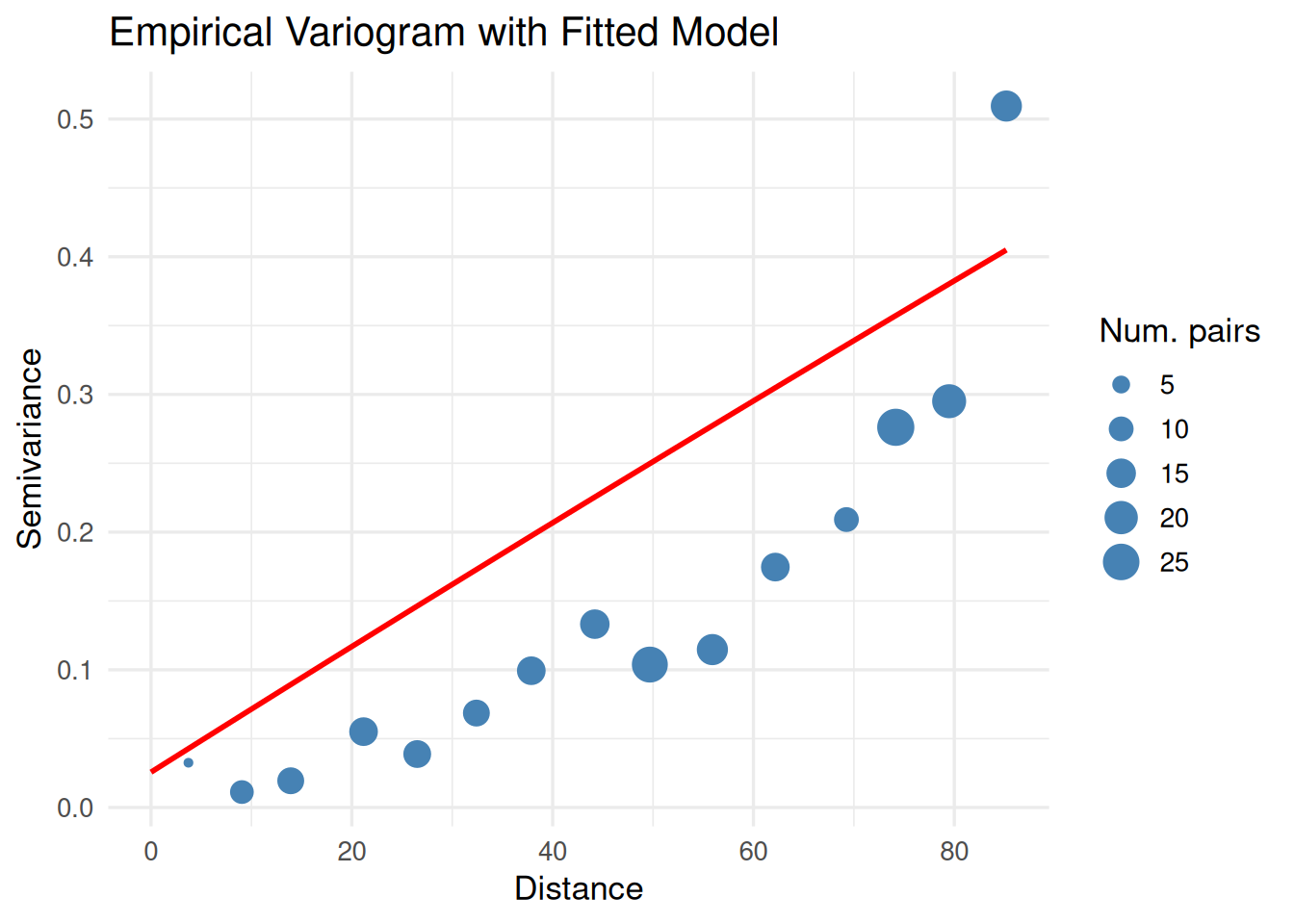
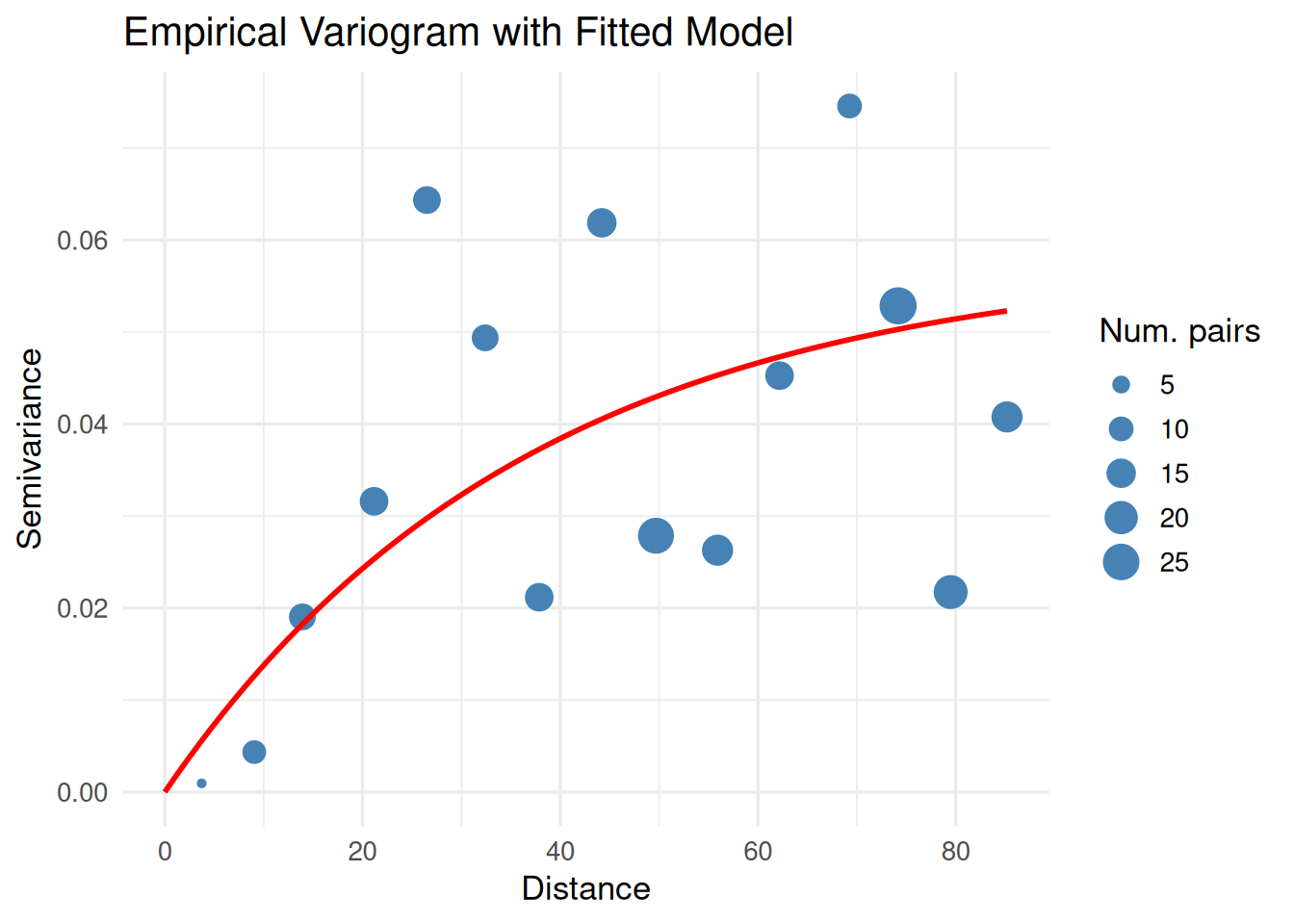
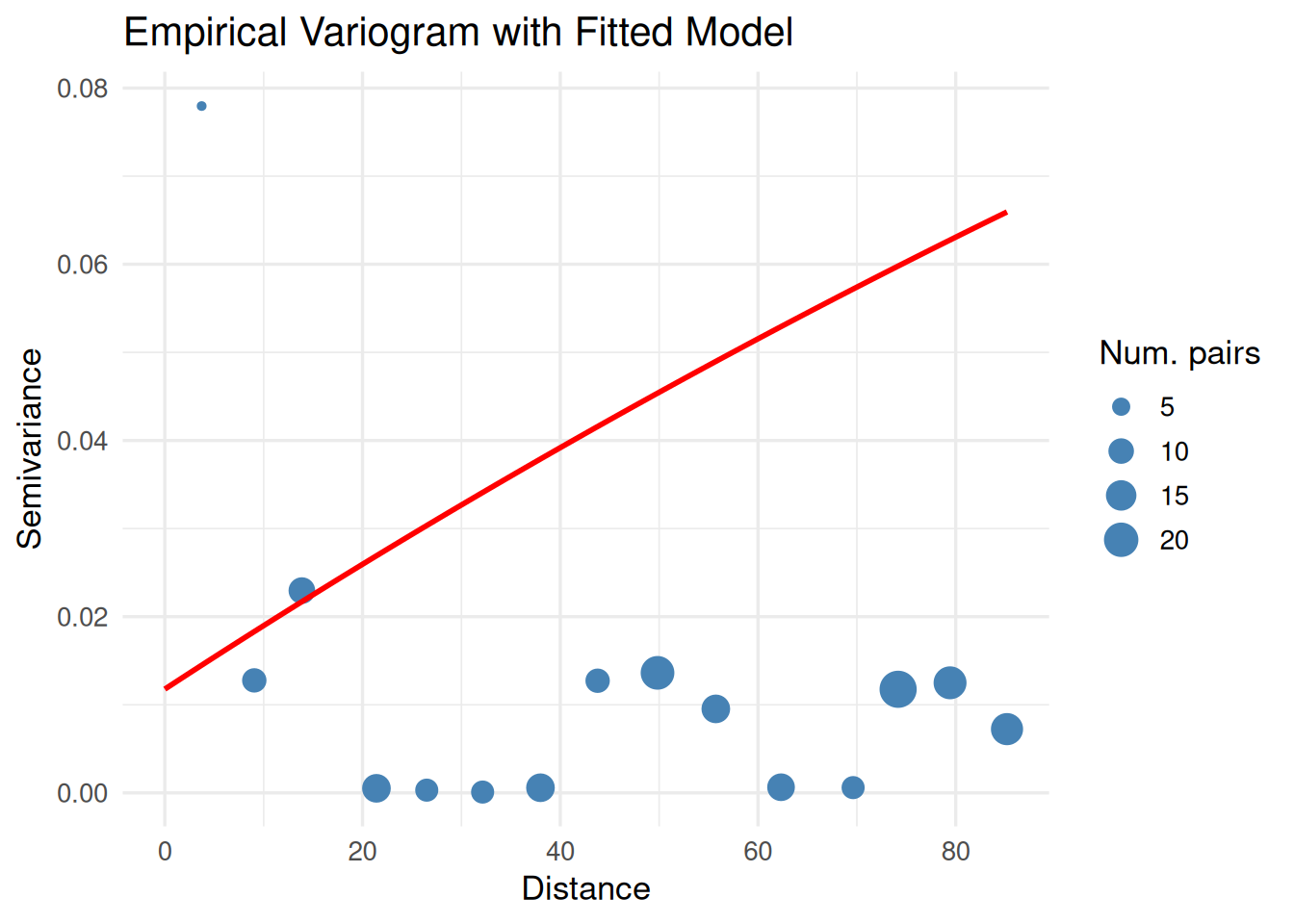
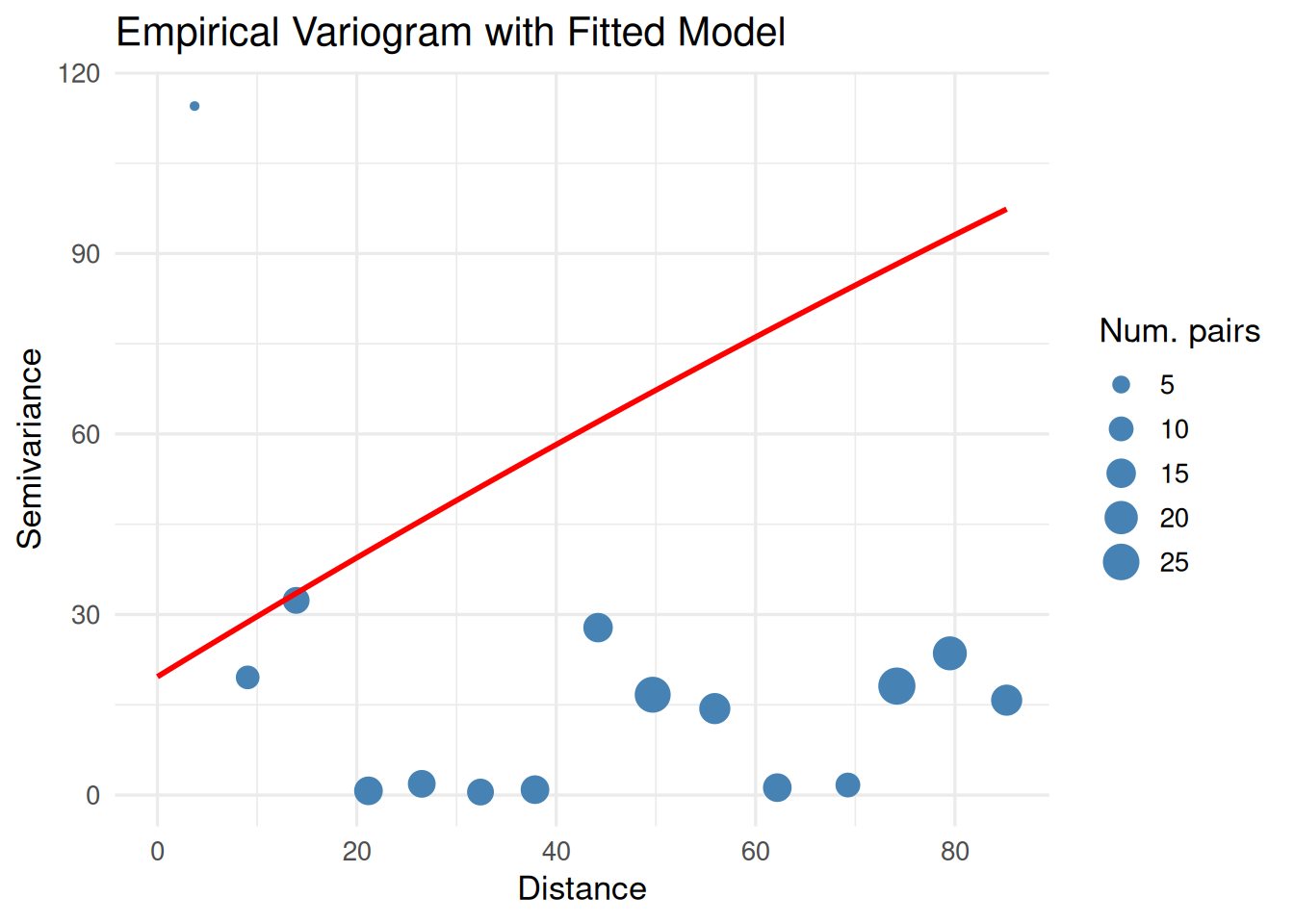
    vgm_emp <- variogram(mean_value ~ 1, data = df_sp)
    vgm_fit <- fit.variogram(vgm_emp, model = vgm(
      psill  = max(vgm_emp$gamma),
      model  = MODEL,
      range  = max(vgm_emp$dist) / 2,
      nugget = min(vgm_emp$gamma)
    ))

    vgm_line <- variogramLine(vgm_fit, maxdist = max(vgm_emp$dist))

    print(
      ggplot() +
        geom_point(data = vgm_emp, aes(x = dist, y = gamma, size = np), color = "steelblue") +
        geom_line(data = vgm_line, aes(x = dist, y = gamma), color = "red", linewidth = 1) +
        labs(title = "Empirical Variogram with Fitted Model",
             x = "Distance", y = "Semivariance", size = "Num. pairs") +
        theme_minimal(base_size = 13)
    )

    # --- 4. Perform Ordinary Kriging ---
    krig_result <- suppressWarnings(krige(
      mean_value ~ 1,
      locations = df_sp,
      newdata = grid,
      model = vgm_fit
    ))

    # --- 5. Convert to data frame and clip to convex hull ---
    krig_df <- as.data.frame(krig_result)
    names(krig_df)[names(krig_df) == "var1.pred"] <- "predicted"
    names(krig_df)[names(krig_df) == "var1.var"]  <- "variance"

    # Build convex hull from sample points
    pts_sf  <- st_as_sf(df, coords = c("longitude", "latitude"), crs = 4326)
    hull_sf <- st_convex_hull(st_union(pts_sf))

    # Clip kriged grid to hull
    krig_sf      <- st_as_sf(krig_df, coords = c("longitude", "latitude"), crs = 4326)
    krig_clipped <- st_filter(krig_sf, hull_sf)
    krig_df      <- cbind(st_drop_geometry(krig_clipped), st_coordinates(krig_clipped))
    names(krig_df)[names(krig_df) == "X"] <- "longitude"
    names(krig_df)[names(krig_df) == "Y"] <- "latitude"

    # --- 6. Plot surface map ---
  librarian::shelf(quiet = TRUE, ggplot2, viridis, sf, ggspatial, rnaturalearth, rnaturalearthdata)

  # --- Basemap ---
  world <- ne_countries(scale = "medium", returnclass = "sf")

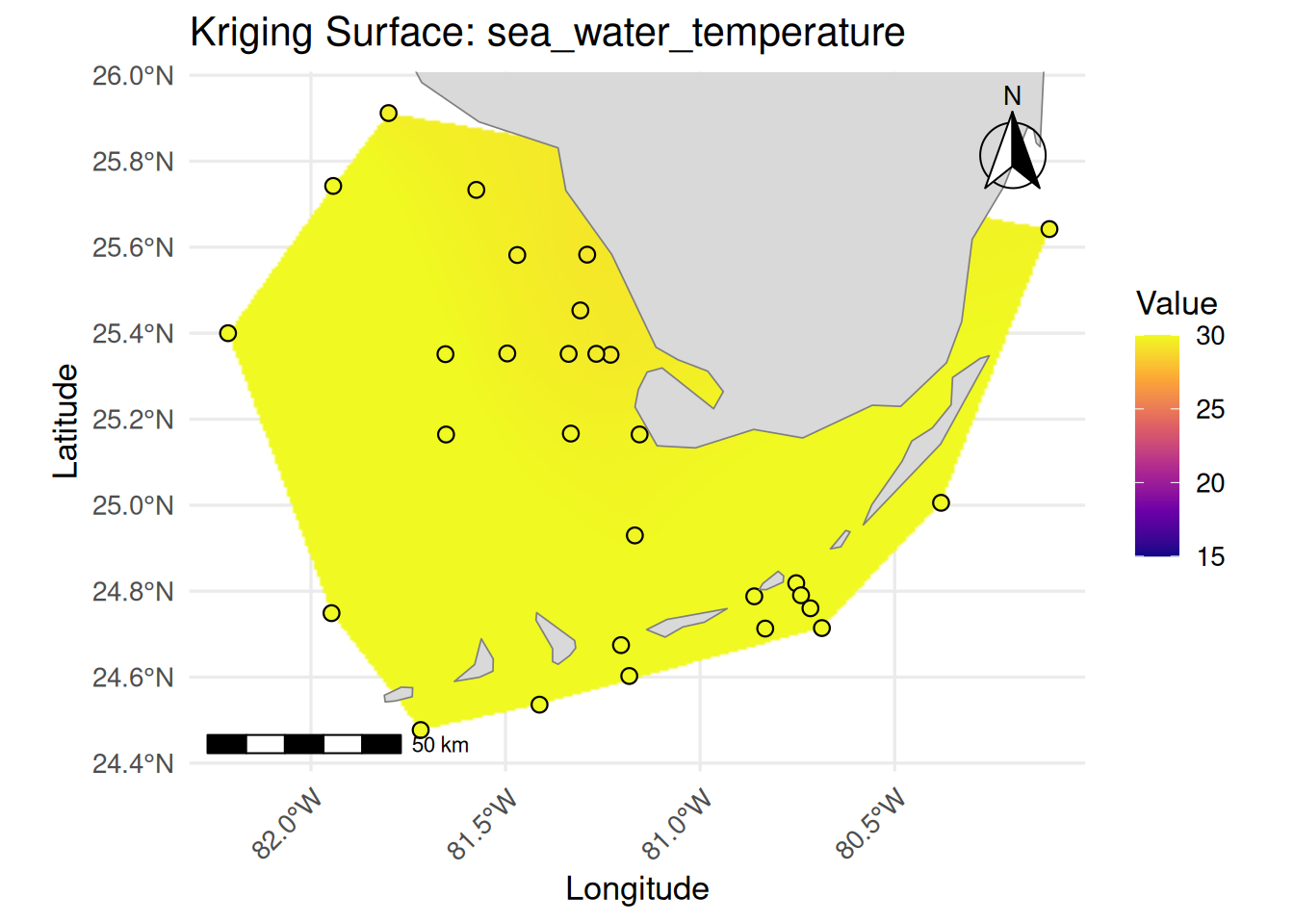
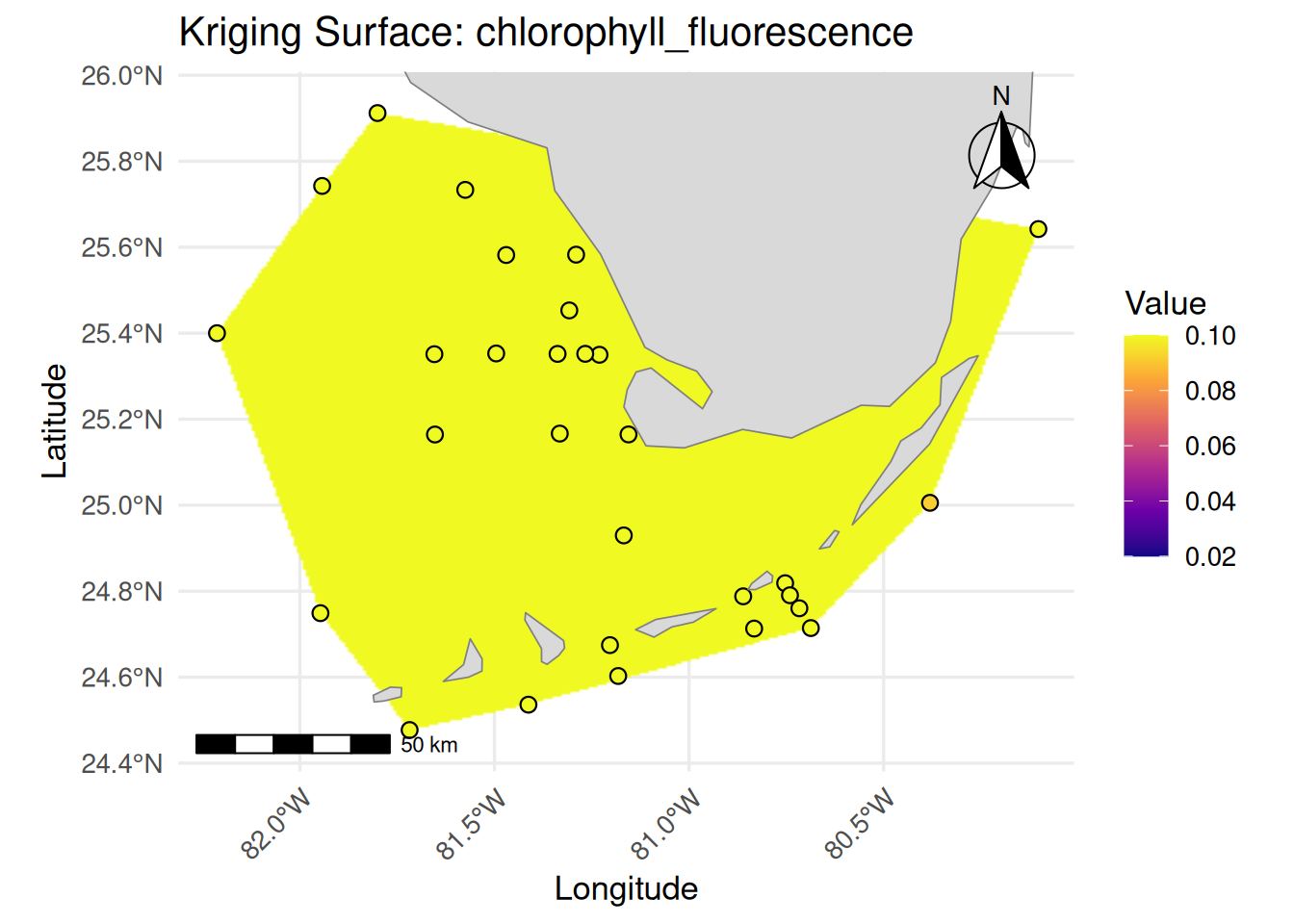
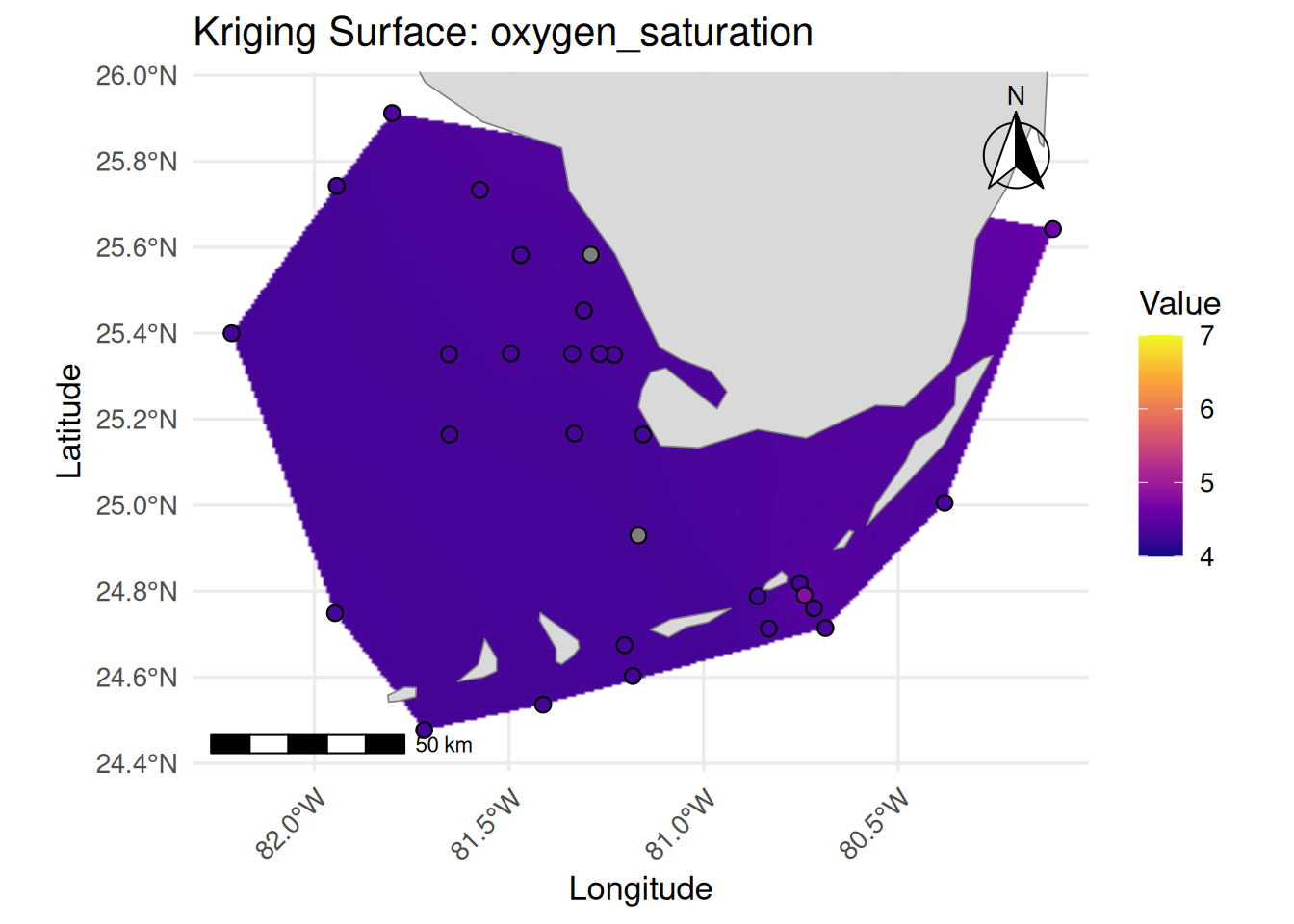
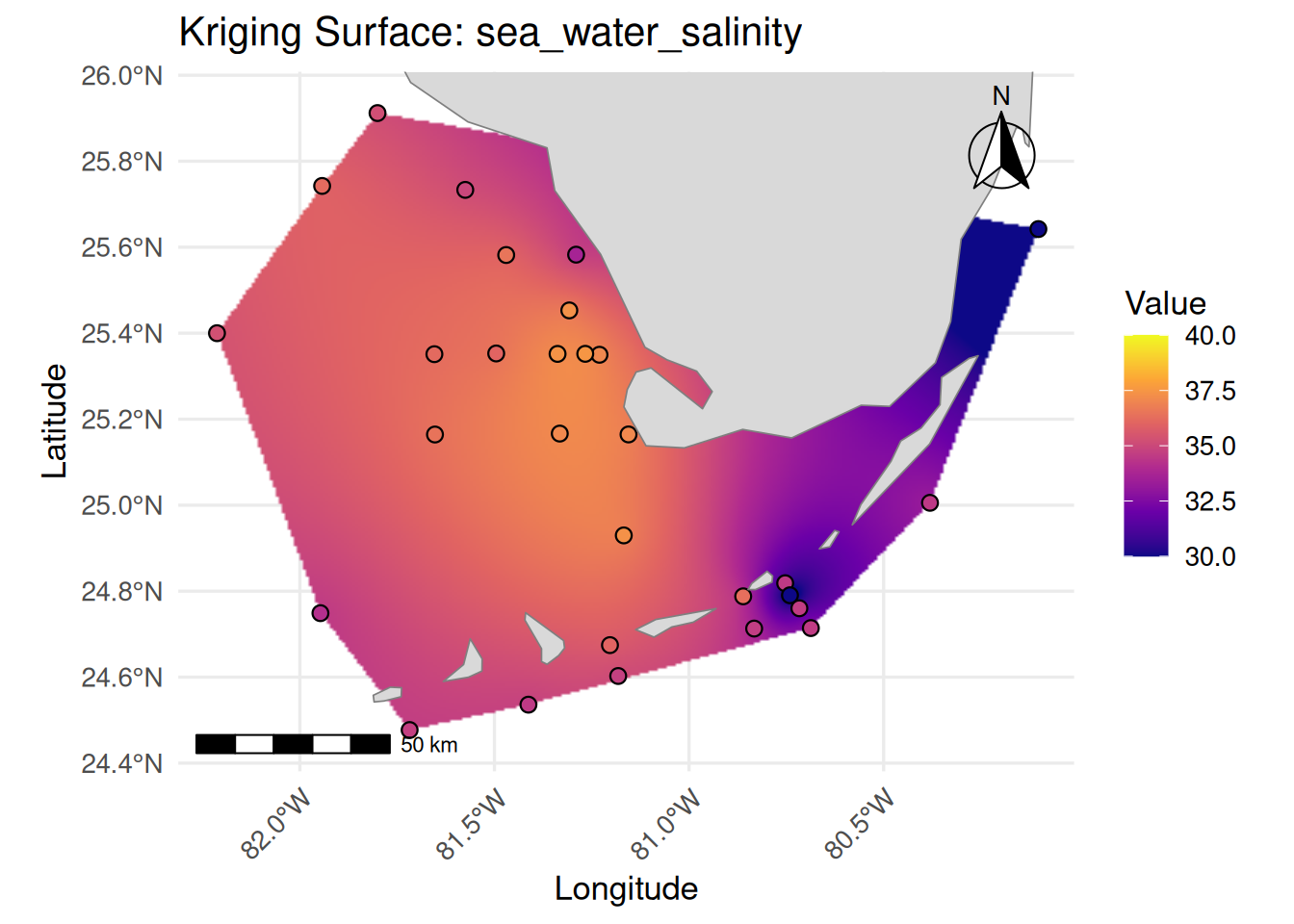
    print(
      ggplot() +
        # Kriged surface
        geom_raster(data = krig_df, aes(x = longitude, y = latitude, fill = predicted), interpolate = TRUE) +
        geom_point(data = df, aes(x = longitude, y = latitude, fill = mean_value),
                   shape = 21, color = "black", size = 2.5) +
        scale_fill_viridis_c(
          option = "plasma",
          name   = "Value",
          limits = c(legend_min, legend_max),
          oob    = scales::squish
        ) +
        # Basemap
        geom_sf(data = world, fill = "gray85", color = "gray50", linewidth = 0.3) +

        # Colorscale with hardcoded limits
        scale_fill_viridis_c(
          option  = "plasma",
          name    = "Value",
          limits  = c(legend_min, legend_max),
          oob     = scales::squish   # squish values outside limits into the color range
        ) +
        # Zoom to data extent with a small buffer
        coord_sf(
          xlim = c(min(krig_df$longitude) - 0.1, max(krig_df$longitude) + 0.1),
          ylim = c(min(krig_df$latitude)  - 0.1, max(krig_df$latitude)  + 0.1),
          expand = FALSE
        ) +
        annotation_scale(location = "bl") +
        annotation_north_arrow(location = "tr", style = north_arrow_fancy_orienteering()) +
        labs(
          title = paste("Kriging Surface:", var_name),
          x = "Longitude", y = "Latitude"
        ) +
        theme_minimal(base_size = 13) +
        theme(axis.text.x = element_text(angle = 45, hjust = 1))
    )
  },
  error = function(e) {
    print(glue::glue("error generating surface map for {var_name}:"))
    print(e)
  })
}

createSurfaceMap(cruise_df, "sea_water_temperature", 15, 30)